
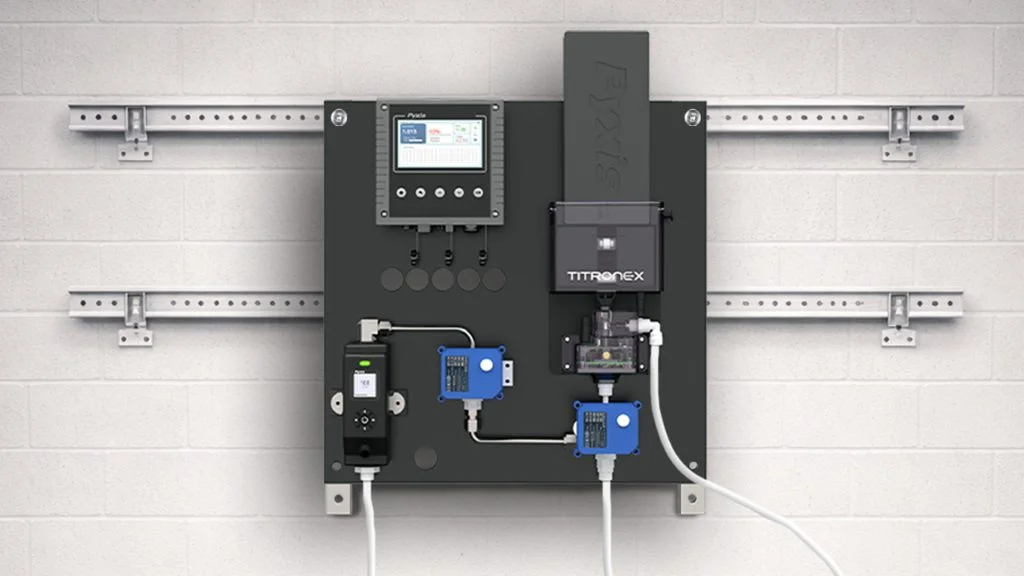
For decades, online colorimetric analyzers have followed the same design philosophy: pumps, tubing, reagent manifolds, rotating components, and constant maintenance. In theory, these systems promised laboratory-grade chemistry in real time. In practice, operators often inherited a different reality — clogged tubing, worn peristaltic pumps, drifting flow rates, reagent instability, and frequent service calls.
That maintenance burden has become so normalized across water treatment that many facilities simply accept it as part of doing business.
The Titronex™ MFA-Series from Pyxis Lab, Inc. challenges that assumption entirely.
Rather than refining the traditional architecture, the MFA-Series effectively removes the mechanical complexity that has historically defined online colorimetric analyzers. The result is a new generation of pump-free wet chemistry analyzers engineered around simplicity, reliability, and long-term operational stability.
Moving Beyond the Peristaltic Pump
At the core of the MFA-Series is a deceptively simple idea: eliminate the components most likely to fail.
Traditional wet chemistry analyzers rely heavily on multiple peristaltic pumps and tubing assemblies to move sample water and reagents through the system. Over time, tubing fatigue, pump wear, chemical attack, and flow inconsistency create measurement drift and maintenance headaches.
The MFA-Series replaces that architecture with a pressurized process-flow design utilizing ultrasonic flow control and sealed disposable reagent cartridges.
Instead of depending on pumps to maintain stability, the analyzer regulates sample flow directly from the process stream using integrated ultrasonic flow measurement and motorized valve control. Reagents are introduced using a hybrid gravity-assisted tube roller mechanism rather than conventional metering pumps.
The practical impact is significant:
- Fewer moving parts
- Reduced mechanical wear
- Lower maintenance frequency
- Improved long-term measurement repeatability
- Simplified servicing for operators
In industrial or municipal environments where labor availability and uptime increasingly matter, that simplification is not just convenient — it is strategic.
Designed for Real World Conditions
What separates the Titronex™ MFA platform from many compact analyzers is that it was clearly designed by people familiar with actual field conditions.
The analyzer accommodates inlet pressures from 7.25–72.5 psi and regulates sample flow between approximately 100–500 mL/min using integrated ultrasonic control.
The system supports both constant-flow-to-drain operation and water-saving modes, allowing facilities to reduce unnecessary water consumption during standby periods.
The hardware itself reflects industrial priorities:
- 316L stainless steel wetted components
- Touchscreen calibration interface
- Dual 4-20mA outputs
- RS-485 Modbus communications
- Relay outputs
- USB data export
- Optional NB-IoT / 4G remote connectivity
This is not laboratory instrumentation adapted for industrial service. It is industrial instrumentation first.
One Platform, Multiple Chemistry Applications
The MFA-Series also stands out because of its versatility. Rather than a single-purpose analyzer, the platform supports multiple chemistry applications across industrial water treatment.
MFA-600 Ultra-Low Hardness Monitoring
The MFA-600 was developed for applications where hardness breakthrough can create immediate operational risk, including:
- Boiler feedwater
- Softener effluent
- Reverse osmosis feedwater
- High-purity process systems
Using a patent-pending non-staining Chlorophosphonazo III reagent chemistry, the analyzer measures calcium hardness down to approximately 0.035 ppm detection limits.
In facilities where hardness leakage can rapidly damage equipment or compromise steam quality, early detection is critical.
MFA-100 and MFA-110 Chlorine Monitoring Simplified
The MFA-100 and MFA-110 target free and total chlorine measurement using a stabilized single-liquid DPD reagent system designed for extended shelf life.
By combining buffer and indicator chemistry into a single reagent cartridge, the system simplifies reagent handling while extending operational runtime compared to traditional multi-reagent chlorine analyzers.
For cooling water, potable water, food processing, and industrial disinfection systems, that translates directly into reduced operator intervention.
MFA-310 Orthophosphate Control
Orthophosphate remains one of the most important parameters in corrosion control and wastewater nutrient management.
The MFA-310 applies absorbance-based colorimetric analysis using the molybdovanadate method to provide stable phosphate monitoring for industrial and municipal applications.
MFA-400 Polymer Feed Verification
The MFA-400 focuses on anionic dispersant polymer measurement using a turbidimetric method suited for industrial cooling and process water programs.
For facilities attempting to optimize chemical feed efficiency while reducing overfeed costs, direct polymer verification can become an important operational tool.
A Shift Toward Low-Maintenance Analytics
The larger significance of the MFA-Series may not be any single chemistry method. It is the broader design philosophy behind the platform.
Industrial facilities increasingly want:
- Fewer maintenance-intensive analyzers
- More automation
- Remote visibility
- Longer reagent life
- Reduced service labor
- Simplified installation
- Higher reliability in unmanned environments
The MFA-Series aligns directly with that trend.
By rethinking analyzer architecture around flow stability, cartridge simplicity, and pump-free operation, Pyxis Lab is addressing one of the biggest frustrations operators have tolerated for years: analyzers that require too much attention to stay trustworthy.
In a market where uptime, staffing, and operational efficiency matter more than ever, low-maintenance analytical systems are no longer a luxury.
They are becoming the new standard.

